What Went Wrong
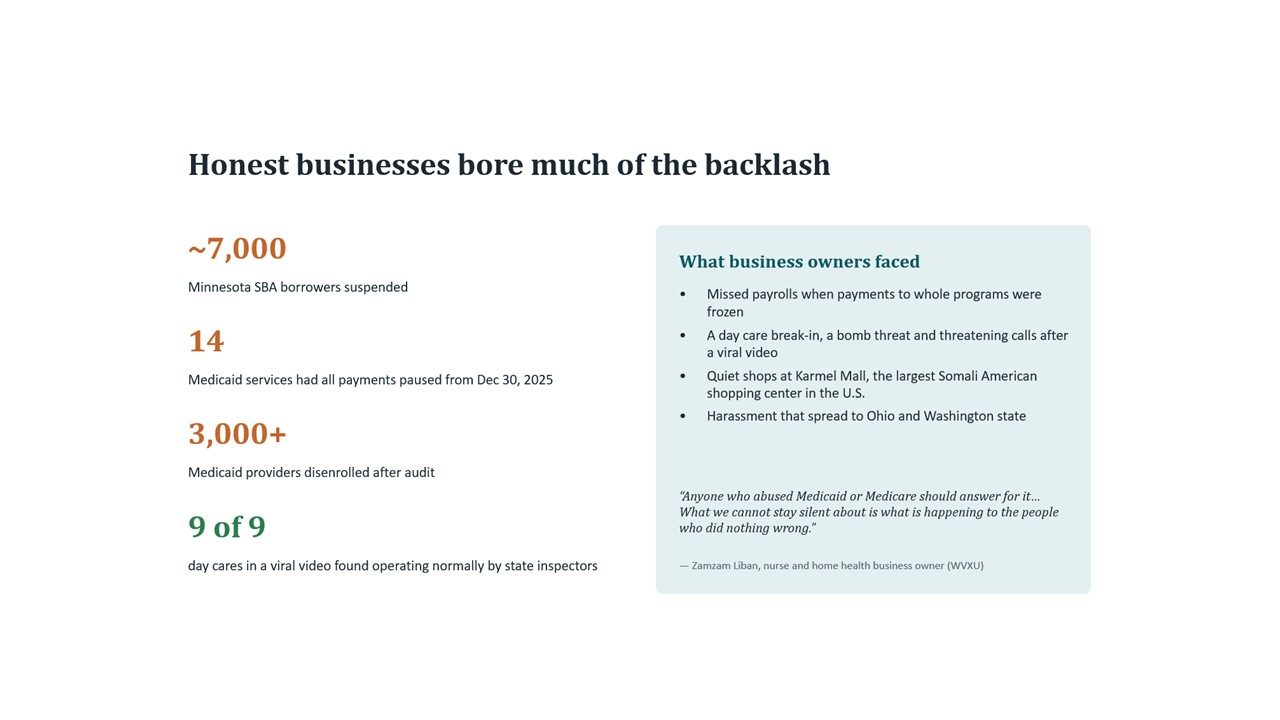
Recent fraud cases revealed the same weaknesses across nearly every program. Spending exploded with no alarm: autism therapy billing grew 55 times from 2018 to 2024. Anyone could enroll and bill. Impossible bills were paid, including one group home that billed 45 hours of care in a single day. Agencies worked in silos, warnings were ignored, and schemes spread through kickbacks and trust networks. Then blanket crackdowns hurt honest businesses, with missed payrolls and harassment after viral claims. Our plan turns each weakness into a design rule, guided by one principle: evidence, not identity.

Four Goals
1. Prevent fraud at the front door: growth triggers with independent reviews within 30 days, verified enrollment before a provider's first payment, and automatic rejection of impossible claims. 2. Connect oversight and protect the people doing it: one provider-risk registry shared across state agencies, whistleblower protections and a fully staffed Inspector General. 3. Build a culture of compliance: free training in Somali and English, provider associations with a code of conduct, an anti-kickback campaign through mosques and community media, and compliance mentors. 4. Protect honest businesses: hold only flagged claims, a provider bill of rights with notice and appeal, rapid response to viral claims, and bias-incident reporting.

For Providers: Ten Rules for Honest Billing
Bill only for services actually delivered by qualified staff. Keep daily records of who was served, by whom, when and for how long. Never bill more hours than your staff could work. Never pay or accept a kickback, and never pay families or clients to enroll. Keep business and personal money separate. Know each program's rules and train staff yearly. Allow unannounced inspections. Correct and repay errors as soon as you find them. Report suspected fraud to the state tip line. Walk away from anyone offering to handle your enrollment "for a percentage" or calling a program "easy money."
Status: 24-Month Implementation Plan
Integrity and Opportunity rolls out in four phases with three gates: rules adopted by month 3, checks live by month 9, and the Inspector General operating by month 18. Success is judged on both halves of the vision, fewer losses to fraud and fair, on-time payment of honest providers, with results published every six months. Iftiin will co-design training, outreach and a good-standing program with Somali-led organizations, mosques, business associations and community media. Providers, agencies and associations who want to take part are welcome to contact us.
Contact us to learn about our data initiatives or partnership opportunities.
Telephone: 651-333-9285 (Fax: 651-204-9510)
E-mail: ashire@iftiincdf.org
Address: 450 Syndicate Street North, Suite 275, Saint Paul, MN 55104